

Oysters Worth Killing For
by Jennifer Stewart Kornegay
July 2, 2026

“I think it’s just in you,” says Lane Zirlott. The owner and operator at Murder Point Oysters ponders what draws folks like him and his kin to work the sea as he watches his team wade among the submerged baskets at Murder Point’s oyster farm in Grand Bay, checking on the oysters growing inside them. Currently, the baskets hold approximately 12 million oysters, making Murder Point the largest oyster farm in Alabama and in The Gulf.
Five generations of the Zirlott family have pulled a living from the water, so it’s little surprise Lane dove into the seafood industry. Saltwater runs through his veins. But the family’s foray into oysters is new. For more than three decades, Lane’s dad Brent chased and netted shrimp, and as a kid, Lane tagged along in the summers. When he grew up, Lane joined his dad fulltime, embarking on weeks-long trips to catch the crustaceans, running from Texas to Key West and then up to Virginia, where they hunted royal red shrimp in deep waters. “Shrimping had me moving around our country’s coastline my entire life,” Lane says. “I bet I’ve crossed patches of the Gulf that maybe only a few other people have ever been to, and I enjoyed the pursuit.”
While Lane loved time on the open ocean, and they always returned home to Alabama, being away for long stretches took its toll. “As a young man, I sometimes felt like I was missing out on things,” he says. “And then I got married and had a little boy and then a little girl, and it was hard to be gone.”

Submerged baskets on Murder Point Oyster Farm to raise oysters in a contained safe space.
The Zirlotts started thinking about the future of the family business, and around the same time, Alabama’s once productive wild oyster reefs were suffering, putting wild oyster populations in decline. As a remedy, Auburn University’s Shellfish Lab introduced Alabama to oyster farming in the hopes it would give commercial oystermen a way to stay on the water. But the idea caught the attention of others as well. In 2013, Lane’s mom Rosa convinced her husband to join her in taking the Lab’s “oyster farming 101” class.
There, the Zirlotts learned how oyster farming, also called oyster aquaculture, doesn’t try to replace wild oyster harvests but complements them while also creating oysters with an emphasis on quality (in taste and look) that appeals to chefs and oyster connoisseurs.
Like land farming, the off-bottom farming method the Lab taught begins with “seed,” tiny baby oysters that have been collected after mature oysters spawn in facilities called hatcheries. They spend time in nursery tanks to get a little bigger. And once these baby bivalves get big enough, oyster farmers put them in mesh bags or baskets in the water at their farm site and monitor and protect them as they mature.
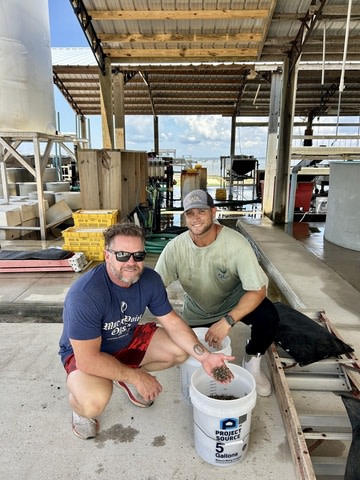
Eric Stewart (right), farm and hatchery manager, with Lane Zirlott.
They keep their oyster crop clean and watch for predators and pests that can harm them or damage their shells’ natural beauty. Some farmers tumble their oysters in machines to manipulate cup size (the depth of the oyster shell), which can impact the meat’s texture. Mother nature handles the rest; farmers don’t medicate or feed their oysters. Like their wild cousins, farmed oysters pull their nourishment from the water. Different farms harvest at different times, but Murder Point oysters are taken out of the water when they reach 2.5 to 3 inches.
The process proved interesting to Lane’s parents. “They loved it,” Lane says. “Dr. Bill Walton, who led the program, had them hooked.” When Lane got back from a shrimping trip, his parents made him an offer. “They asked me to take the class and see what I thought,” he says, “and if I liked it, we’d start an oyster farm that I would work, which would allow me to be home more.”
Lane saw oyster farming’s potential, and so he stepped off the shrimp boat and into bay water and Murder Point Oysters was born. “Once we got going, and we got our oysters in front of people, especially chefs in New Orleans and other spots, it just took off,” he says. A few years ago, the Zirlotts sold the last of their shrimping boats, turning their total attention to their oysters.
Today, Murder Point oysters earn rave reviews from oyster enthusiasts and grace tables in some of the hottest restaurants all over the South, but also in Los Angeles, Las Vegas, Chicago, Boston and even internationally. “Right now, we’re sending about 2,000 sacks of oysters a week to Canada,” Lane says.

Part of Murder Point’s hatchery, these tubes hold tiny baby oysters (called seed), which, once bigger, will be put out in submerged baskets on its farm site.
The orders continue to pour in thanks to a flavor and soft mouthfeel often described as buttery. (Lane calls his oysters “butter babies.”) But Murder Point’s clever branding brings in fans, too. Rosa came up with the name and tagline — “Oysters worth killing for” — but it’s based on a legend surrounding one of the original Murder Point farm sites. “Decades ago, they say a guy killed someone over oyster-harvesting rights in the area,” Lane says.
To meet demand, Murder Point opened a hatchery in 2018 to supply its farm with seed. “I realized if we were gonna stay in this, we needed to do seed ourselves,” Lane says, “so from conception to plate, nobody touches our oysters but us.”
Despite the popularity of Murder Point oysters in and outside of Alabama, Lane notes how some still see a Gulf, warm-water oyster as inferior. But he’s on a mission to change that. “There was a time that Alabama fishermen were known as the best around, and I want to be an ambassador for not just our oysters, but other Alabama- and Southern-farmed oysters, too, to show people they can compete with any other oyster.”
Spreading Southern oyster praise can be tough going in some spots, and the farm labor is intense, but the Zirlotts don’t shy away from hard work. “We’ve had a lot of things go our way, but we’ve put blood, sweat and tears into this too, and God had a lot to do with our success as well,” Lane says. It’s still a family affair, with Rosa, who’s also an owner, working at Murder Point, and Lane’s daughter Laila helping out some in the retail shop fronting the farm’s office in Bayou La Batre. And even as new challenges arise — like silt from recent dredging in Mobile Bay leading to crop losses — Lane’s smile stays put. “I love this and can’t imagine doing anything else.”